The idea came from a conversation that did not begin as one about art.
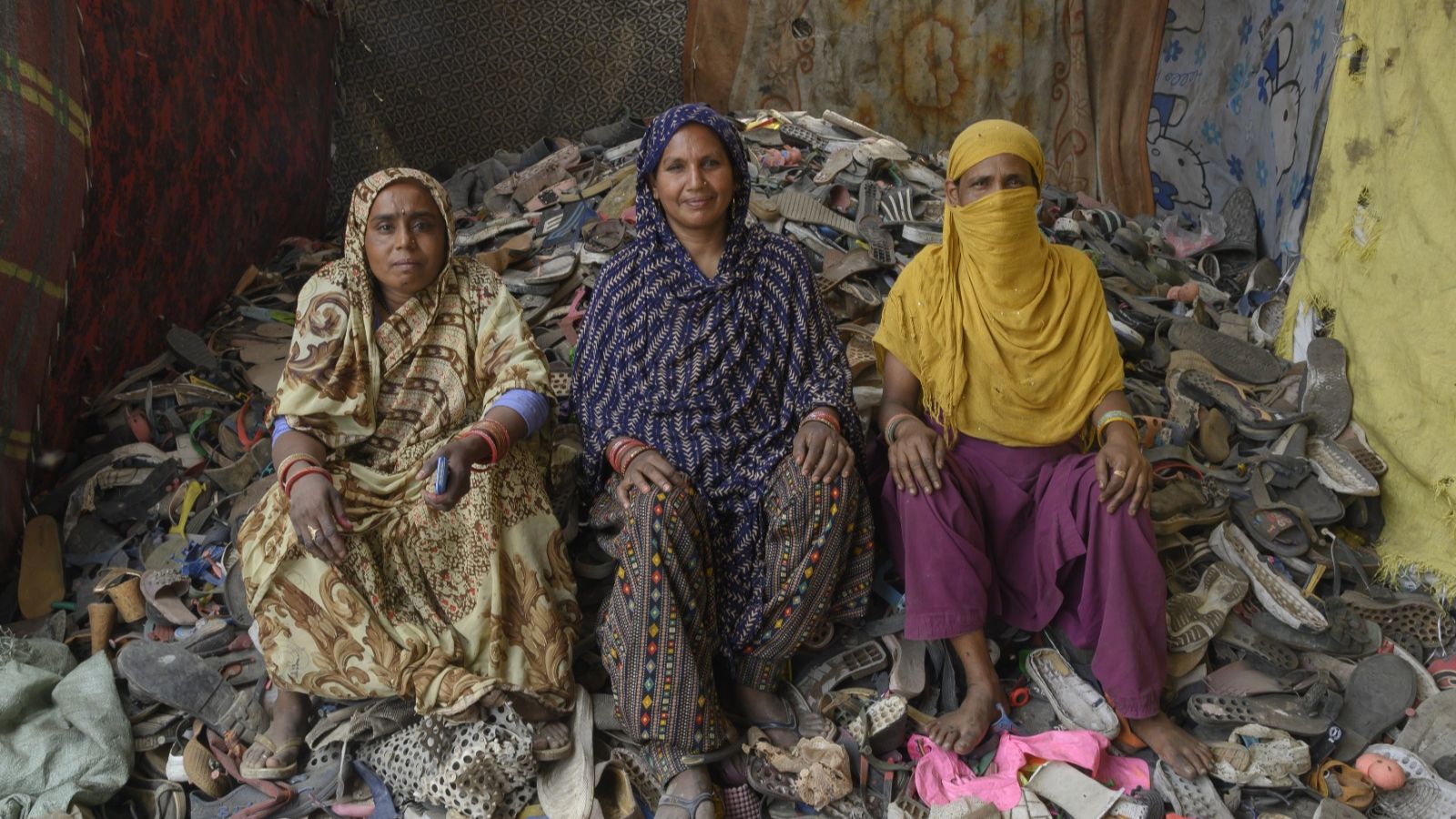
I had been working with women at the Bhalswa landfill for years — meeting them at the site, documenting their hours, trying to understand in policy language what their days actually looked like. When I finally went with a photographer, I did not need to plan the visit. I knew exactly where to take him. I knew which hours the light was worst, which corners smelled like burning plastic, which women would talk and which would not.
That prior knowledge — built over five years with SEWA Bharat — is what made Streets, Homes, Landfills: Women in City’s Waste Management possible. The exhibition, which opened at Bikaner House in June 2024, was not designed from the outside in. It grew from the inside out.
What the numbers say — and what they don’t
After eight hours of segregation at the Bhalswa landfill, a woman like Rita can collect roughly 25 kilograms of waste that can be sold. We displayed those 25 kilograms in eleven sorted boxes: toothbrushes, crushed cans, dusty bottles, plastic bags. The numbers were calculated using average rates given by scrap dealers in Bhalswa.
The boxes were precise. They were also, in some sense, brutal in their precision. They told you the output but nothing about the person — nothing about working from 8 am to 8 pm, nothing about switching to night shifts during the heatwave because standing in the sun was no longer survivable, nothing about the fear of men who circulate around the landfill after dark.
That gap between data and experience is the reason I believe curation is a form of policy work. A statistic can document the 25 kilograms. Only a photograph, a living woman explaining which box she would use — holding up a tattered sandal she would have scrubbed, repaired, and sold — can make you feel what those 25 kilograms cost.
The curatorial choice that mattered most
My co-curator Laxmi Bohora and I made one decision early on that shaped everything else: the women would not be passive objects in this exhibition. They would not stand next to their photographs like props at a press event.
At the inauguration, we introduced them by name. We invited them into conversation with attendees — about their work, their routes, their bodies at the end of a shift. One woman picked up a sandal from a prop pile and walked the room through her sorting process as if she were back at Bhalswa. The people watching were not watching a representation of her labour. They were watching her expertise.
This distinction matters enormously to me. Development work has a long and uncomfortable history of putting poor women on display in ways that confirm the observer’s assumptions and foreclose the subject’s complexity. An exhibition can reproduce that dynamic very easily — through the wrong caption, the wrong framing, the wrong balance of scale between a face and the garbage surrounding it.
We tried to ensure that in every artwork, the visual weight of the garbage was counterbalanced by the presence of one woman, sometimes two — her identity legible as both a worker and a person, not as a symbol of a social problem to be solved.
What an exhibition can and cannot do
The women themselves held no illusions about this. One told me, quite directly, that she was doubtful about the long-term benefits. Her husband was in debt. Her struggles would continue after the closing reception.
She was right to be doubtful. An exhibition does not change wages. It does not accelerate the Bhalswa remediation deadline, which has now been extended to 2025. It does not give waste-pickers formal employment status or access to social security under the new labour codes.
But another woman said something I have not stopped thinking about.
“This could be our first step towards financial stability. This says — look at us.”
That is not a small thing. Recognition is not sufficient, but it is also not nothing. For workers whose labour props up Delhi’s waste management system while remaining entirely outside its formal acknowledgement, being seen — at Bikaner House, in a room with diplomats and policy people and journalists — is a form of claim-making. It inserts them into a conversation about the city that has been happening without them.
The exhibition was organised by SEWA Delhi in partnership with the Embassy of the Netherlands, SEWA Bharat, and WIEGO. That coalition itself — labour organisations, international development institutions, and the women themselves — is a small model of what multi-stakeholder advocacy can look like when the people most affected are not an afterthought.
What I carry from it
I have been asked whether this kind of work — curatorial, aesthetic, public-facing — is a departure from policy work. I do not think it is. The policy brief I write about waste-picker livelihoods will be read by a small number of officials, most of whom already work in this space. The exhibition was seen by people who had never thought about who handles their garbage.
Those are not competing projects. They are the same project in different registers.
The woman who worked from 8 am to 8 pm during the June heatwave does not need either a beautiful photograph or a well-drafted social security clause in isolation. She needs both — the recognition that makes her legible as a rights-holder, and the policy infrastructure that actually delivers those rights.
My job, as I understand it, is to work in both directions at once.
Streets, Homes, Landfills: Women in City’s Waste Management was a six-day exhibition held at Bikaner House, New Delhi in June 2024, organised by SEWA Delhi in partnership with the Embassy of the Netherlands, SEWA Bharat, and WIEGO. Covered by The Indian Express, June 26, 2024.