Overview
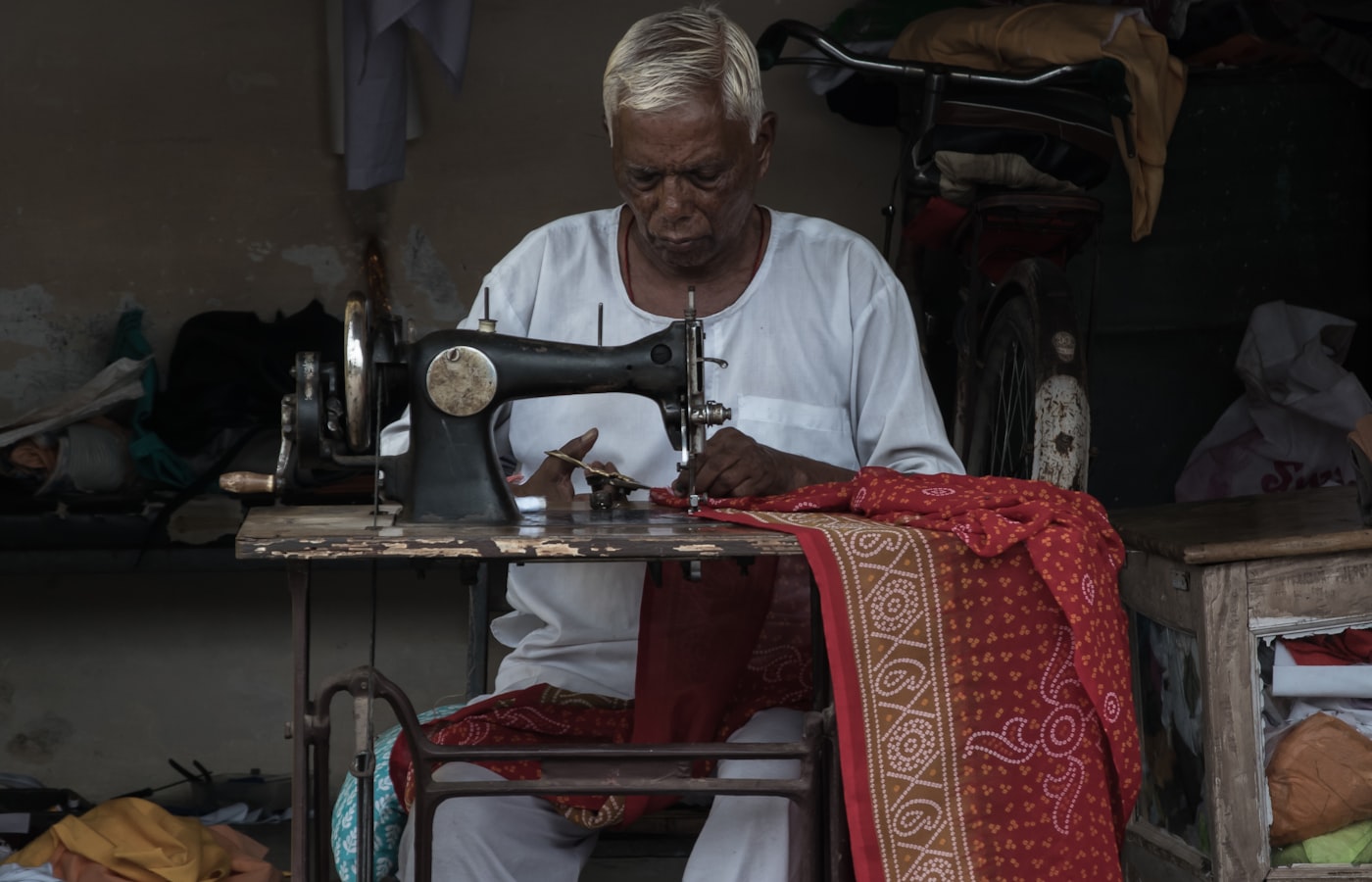
The Indian economy runs, in significant part, on work that does not appear in GDP accounts, is excluded from labour force surveys, and is invisible to welfare administration. Home-based workers — embroiderers, bidi rollers, garment assemblers, papad makers — produce for global supply chains from their kitchen floors. Domestic workers — cooks, cleaners, caregivers — reproduce the conditions for every other kind of work. Together, they constitute an estimated 5–7 crore workers who are largely absent from formal count.
Invisible Labour was a public exhibition and visual archive that attempted to document, with care and specificity, the daily rhythms, economic terms, and social conditions of this work. The exhibition was shown at three venues in 2022–23 and has since been adapted into a travelling format.
The Archive
The archive at the core of the exhibition was built over two years of fieldwork in Delhi, Jaipur, and Surat — cities with significant concentrations of home-based work in different industries.
Delhi: Domestic workers and home-based garment workers in Trilokpuri, Seelampur, and Govindpuri. We documented piece-rate structures, contractor relationships, and the intersection of domestic and paid work in the same physical space.
Jaipur: Home-based embroidery and block-printing workers supplying Rajasthani textile exporters. We traced supply chains upward through contractors and aggregators to exporters, and documented how value extraction occurred at each step.
Surat: Diamond polishing — a home-based industry concentrated among migrant workers from Saurashtra — and power-loom weaving, where the gender division of labour was sharply defined and female contribution systematically undervalued.
Exhibition Structure
The exhibition was organised around five thematic sections:
The Work Itself: Large-format photographs of hands — bidi rolling, embroidering, sweeping, caregiving. No faces; hands as the site of labour and dexterity. Text panels with piece rates, daily output volumes, and hourly equivalent earnings.
The Contractor’s Chain: Infographics tracing supply chains from homeworker to exporter. Interactive stations where visitors could see what the product sold for at retail and trace what percentage reached the worker.
The Day: Audio installations of workers describing their day — when work begins, when it ends, how it intersects with cooking, childcare, elder care. Several of the recorded accounts were in Rajasthani and Gujarati, played with subtitles, to resist the flattening of regional experience.
Counted and Uncounted: A data installation comparing NSS (National Sample Survey) employment estimates with alternative estimates from worker organisations. Visualisations showing how survey design choices — who counts as a “worker,” what counts as “work” — determine who is visible to policy.
Demands: Text panels and audio of workers articulating what they wanted — minimum piece rates, welfare board registration, ESIC coverage, crèche facilities. Their own words, not summarised.
Reception and Impact
The Delhi showing drew 4,200 visitors over three weeks. We held six public programmes, including a panel with home-based workers addressing questions from the audience directly — an unusual format that generated sustained press coverage and a short documentary by a Delhi-based filmmaker.
The Jaipur showing was hosted in partnership with a textile workers’ organisation and reached audiences outside the typical arts and policy circuit. Post-exhibition, one contractor network we had documented agreed to a minimum piece-rate negotiation with an affiliated worker cooperative.
The exhibition materials — photographs, data visualisations, audio — were made freely available for use by worker organisations, NGOs, and journalists under a Creative Commons licence.
The Book
A companion publication, Invisible Labour: Home, Work, and the Edges of the Indian Economy, was published in limited print. It includes expanded field notes, extended oral history excerpts, and analytical essays contextualising the documentation within debates on informal labour and care economies.
Photography by Siddharth Sethi. Research and curation by Anshu Jha. Audio editing by Priya Mehta. Supported by the Rosa Luxemburg Stiftung and a documentation grant from the India Foundation for the Arts.